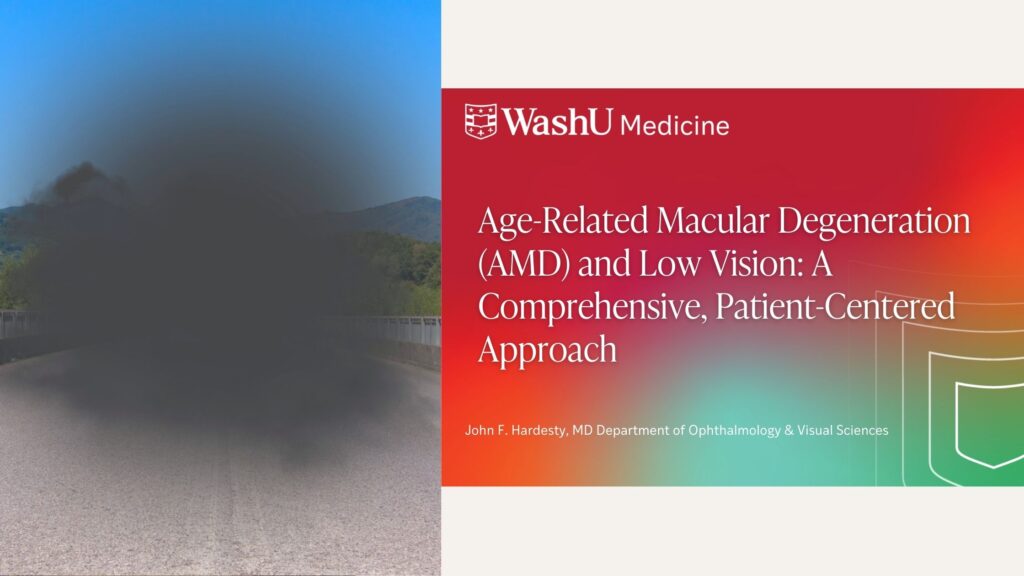
Age-related macular degeneration (AMD) is a common condition affecting the macula—the central part of the retina responsible for detailed vision. It is a leading cause of vision loss in people 50 years or older. Understanding the condition, recognizing early changes, and knowing what support is available can help patients maintain both vision and quality of life.
What Is AMD?
AMD is best described as age-related damage or deposits in maculathat may or may not interfere with vision, particularly in its early stages. Many patients ask whether there is a “good” or “bad” form of AMD. Clinically, AMD is categorized as either:
- Dry AMD, which is more common and typically progresses slowly. Dry AMD is when parts of the macula get thinner with age and tiny deposits called drusen build up.
- Wet AMD, a less common but more visually threatening form caused by abnormal blood vessel growth beneath the retina, which can cause scarring of the macula.
Both forms require ongoing monitoring. Early identification of progression—especially from dry to wet AMD—can make a meaningful difference in visual outcomes.
When Do Patients Notice Vision Changes?
Many patients with early AMD have no noticeable symptoms. Functional vision changes often become apparent when central vision is affected, making everyday activities such as reading, watching television, or recognizing faces more difficult.
Patients may also notice visual distortions, including:
- Straight lines appearing wavy
- Floor tiles or patterns looking uneven
- Door frames or text appearing distorted
Any new or worsening visual symptoms should be reported promptly to an eye care provider.
Low Vision and AMD: Support Beyond Medical Treatment
While medical management remains a cornerstone of AMD care, it is only one part of supporting patients as they navigate vision changes. Low vision rehabilitation and occupational therapy (OT) can offer practical, life-changing strategies for individuals with AMD.
“Many patients with AMD really benefit from low vision or occupational therapy. These services provide practical tools and strategies that can make a meaningful difference in daily life and help patients return to activities they thought they had lost because of their vision.”
Alexander Lyss, OD, WashU Medicine

Occupational therapists and low vision specialists focus on helping patients adapt to vision changes by:
- Teaching strategies to improve lighting, contrast, and organization at home
- Introducing magnification and adaptive technologies
- Supporting independence in daily activities such as reading, cooking, and managing medications
Some patients find particular benefit from closed-circuit television (CCTV) devices, which magnify printed materials and have helped individuals resume activities like reading mail, labels, and newspapers.
Despite their proven benefits, low vision rehabilitation services may be underutilized. Incorporating these therapies alongside medical care can significantly improve daily functioning and overall quality of life.
Research Advancing the Future of AMD Care
At WashU Medicine John F. Hardesty, MD Department of Ophthalmology & Visual Sciences, researchers are actively working to better understand the underlying mechanisms of AMD and identify new therapeutic approaches. Research from the Apte Lab has helped advance understanding of how the immune system and inflammation contribute to retinal disease, including AMD. By studying how immune pathways influence retinal health and abnormal blood vessel growth, this work aims to inform future treatments that go beyond symptom management.
This research-focused approach reflects a broader goal in AMD care: not only preserving vision, but improving long-term outcomes through earlier detection, targeted therapies, and personalized care strategies.
Learn more about the Apte Lab’s research.
Living Well With AMD
For many patients, especially in the early stages, AMD is a condition to be monitored—not feared.
“For most patients, I encourage awareness without becoming overly stressed about AMD, especially early on. Regular monitoring and early reporting of changes can make a meaningful difference in visual outcomes.”
Alexander Lyss, OD, WashU Medicine Ophthalmology
Regular eye exams, consistent self-monitoring, and open communication with an eye care provider are key components of living well with AMD. With advances in research, treatment options, and supportive care services, many patients continue to lead active, fulfilling lives.
About WashU Medicine
WashU Medicine is a global leader in academic medicine, including biomedical research, patient care and educational programs with 2,900 faculty. Its National Institutes of Health (NIH) research funding portfolio is the second largest among U.S. medical schools and has grown 56% in the last seven years. Together with institutional investment, WashU Medicine commits well over $1 billion annually to basic and clinical research innovation and training. Its faculty practice is consistently within the top five in the country, with more than 1,900 faculty physicians practicing at 130 locations and who are also the medical staffs of Barnes-Jewish and St. Louis Children’s hospitals of BJC HealthCare. WashU Medicine has a storied history in MD/PhD training, recently dedicated $100 million to scholarships and curriculum renewal for its medical students, and is home to top-notch training programs in every medical subspecialty as well as physical therapy, occupational therapy, and audiology and communications sciences.