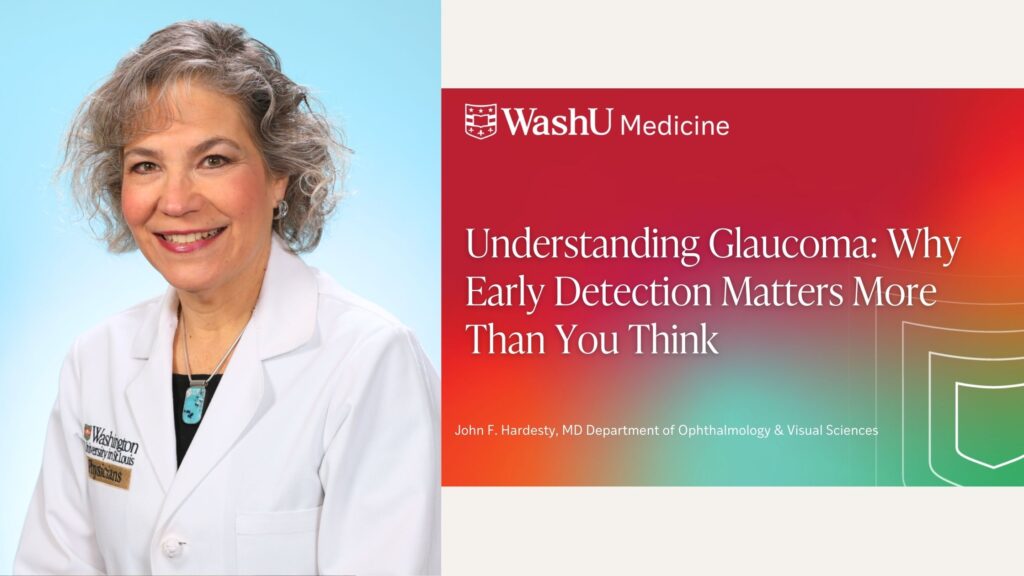
Carla Siegfried, MD, explains why glaucoma often goes unnoticed and how early screening can protect vision
January is Glaucoma Awareness Month, a time to highlight a leading cause of irreversible vision loss that often progresses without warning. Glaucoma affects the optic nerve—the structure that carries visual information from the eye to the brain—and damage to this nerve cannot be reversed.
According to Carla Siegfried, MD, physician with the WashU Medicine John F. Hardesty, MD Department of Ophthalmology & Visual Sciences, glaucoma is commonly linked to elevated eye pressure, the only modifiable risk factor, and all current treatments are designed to lower eye pressure in order to protect the optic nerve.
“Damage to the optic nerve is usually gradual and often starts outside of central vision, so people usually do not notice changes until later stages,” said Siegfried. “That’s why glaucoma is often called the ‘silent thief of sight.’”
Carla Siegfried, MD
Common Myths About Glaucoma Risk
One of the most common misconceptions is that glaucoma causes noticeable symptoms like eye pain or pressure behind the eyes. In reality, these symptoms are rarely associated with glaucoma, especially in its most common forms.
Risk factors include:
- Family history of glaucoma
- Increasing age
- Black or Hispanic ethnicity
- Prior eye injury
- Long-term steroid medication use
Importantly, having normal central vision, normal eye pressure, or no known family history does not rule out glaucoma. Individuals with a first-degree relative (parent or sibling) with glaucoma are up to 10 times more likely to develop the disease.
A comprehensive eye exam remains the only reliable way to diagnose glaucoma.
How Research Is Changing Glaucoma Care
Recent research has led to important changes in how glaucoma is treated. Studies now suggest that early laser treatment may be as effective—or even more effective—than daily eye drops for some patients in lowering eye pressure and protecting vision.
Other advances include:
- Minimally invasive glaucoma surgeries (MIGS) often performed during cataract surgery
- New eye drop formulations
- Drug-delivery implants that reduce the need for daily medications
Looking ahead, future therapies may include gene therapy, neuroprotective treatments that shield the optic nerve, and new surgical techniques designed to better preserve vision over time.
What to Ask During a Glaucoma Evaluation
If you are diagnosed with glaucoma, it’s important to understand your specific condition and treatment options. Siegfried encourages patients to ask:
- What type of glaucoma do I have?
- How severe is it, and is it likely to affect my daily activities?
- What treatment options are available to me?
- Are there any activities I should avoid?
Being informed helps patients play an active role in protecting their long-term eye health.
Protect Your Vision with Regular Eye Exams
Because glaucoma often progresses without symptoms, routine eye exams are essential, especially for individuals with risk factors. Early detection allows for earlier treatment—and the best chance to preserve vision.
During Glaucoma Awareness Month, WashU Medicine Ophthalmology encourages patients and families to schedule comprehensive eye exams and learn more about their personal risk.
About WashU Medicine
WashU Medicine is a global leader in academic medicine, including biomedical research, patient care and educational programs with 2,900 faculty. Its National Institutes of Health (NIH) research funding portfolio is the second largest among U.S. medical schools and has grown 56% in the last seven years. Together with institutional investment, WashU Medicine commits well over $1 billion annually to basic and clinical research innovation and training. Its faculty practice is consistently within the top five in the country, with more than 1,900 faculty physicians practicing at 130 locations and who are also the medical staffs of Barnes-Jewish and St. Louis Children’s hospitals of BJC HealthCare. WashU Medicine has a storied history in MD/PhD training, recently dedicated $100 million to scholarships and curriculum renewal for its medical students, and is home to top-notch training programs in every medical subspecialty as well as physical therapy, occupational therapy, and audiology and communications sciences.