Daniel Kerschensteiner, MD, of the WashU Medicine John F. Hardesty, MD Department of Ophthalmology & Visual Sciences, recently received a four-year renewal of federal grant R01EY034001 to investigate how the retina helps the brain maintain stable vision and coordinate perception with action.
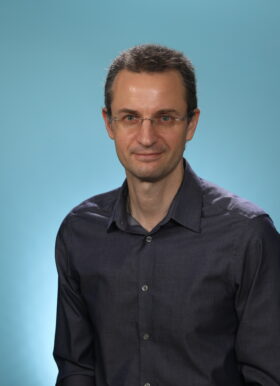
Daniel Kerschensteiner, MD
Bernard Becker Professor of Ophthalmology and Visual Sciences, Vice Chair for Research in Ophthalmology and Visual Sciences, Co-Director of the Neuroscience Ph.D. Program
The renewed project, titled “Multiplexed retinal coding to align perception and action with the saccade-fixation cycle,” explores how specialized nerve cells in the retina, the light-sensitive tissue at the back of the eye, may help the brain interpret visual information as the eyes move through the environment.
Although our eyes constantly shift between points of interest and pause to focus, we generally perceive the world as continuous and stable. Through studies in mice, Kerschensteiner and his research team will examine whether specialized retinal nerve cells send different signals during eye movements, known as saccades, and the periods of relative stillness between movements, called fixations. The research aims to uncover how these signals may help the brain process visual information and guide actions.
“The retina does more than detect light—it begins the work of making sense of what we see,” said Kerschensteiner. “We hope this research will reveal how signals from the eye help the brain maintain clear, useful vision as we look around and interact with the world.”
By advancing understanding of how the retina encodes and communicates visual information, this research could provide important insights into visual processing in eye and brain disorders. The findings may also help researchers evaluate future approaches to preserving or restoring sight, furthering understanding of the complex relationship between retinal function, perception and behavior.