
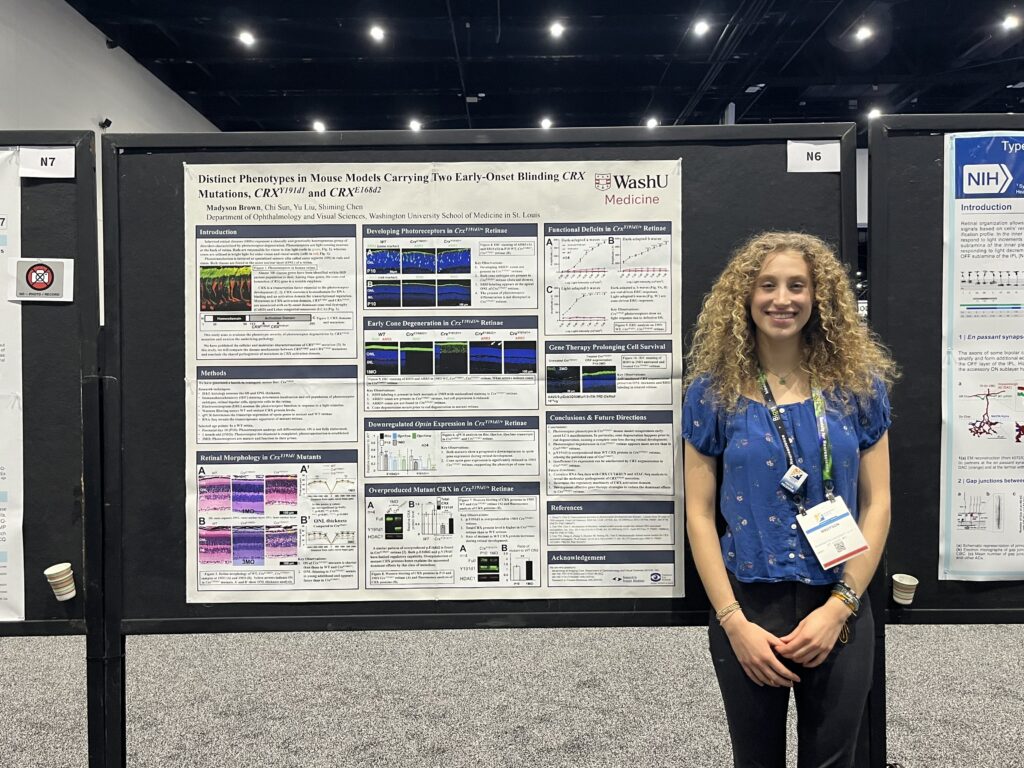
This month, researchers from WashU Medicine John F. Hardesty, MD, Department of Ophthalmology & Visual Sciences joined colleagues from around the world to present their work at SfN’s poster sessions. Sean McCracken, PhD, representing the Williams lab, shared his research on retinogeniculate organization in the visual thalamus after monocular crush injury and explored the role of PTEN-KO in healthy neurons. Additionally, Madyson Brown, BA, and Chu Sun, PhD, representing the Chen lab, presented their collaborative work on distinct phenotypes in mouse models carrying two early-onset blinding CRX mutations, Y191d1 and E168d2.
The Society for Neuroscience (SfN) is the leading global organization for scientists and clinicians who study the brain and nervous system. Since its founding in 1969, it has grown into a nonprofit community of nearly 37,000 members across more than 90 countries, supported by more than 130 local chapters around the world.

About WashU Medicine
WashU Medicine is a global leader in academic medicine, including biomedical research, patient care and educational programs with 2,900 faculty. Its National Institutes of Health (NIH) research funding portfolio is the second largest among U.S. medical schools and has grown 56% in the last seven years. Together with institutional investment, WashU Medicine commits well over $1 billion annually to basic and clinical research innovation and training. Its faculty practice is consistently within the top five in the country, with more than 1,900 faculty physicians practicing at 130 locations and who are also the medical staffs of Barnes-Jewish and St. Louis Children’s hospitals of BJC HealthCare. WashU Medicine has a storied history in MD/PhD training, recently dedicated $100 million to scholarships and curriculum renewal for its medical students, and is home to top-notch training programs in every medical subspecialty as well as physical therapy, occupational therapy, and audiology and communications sciences.