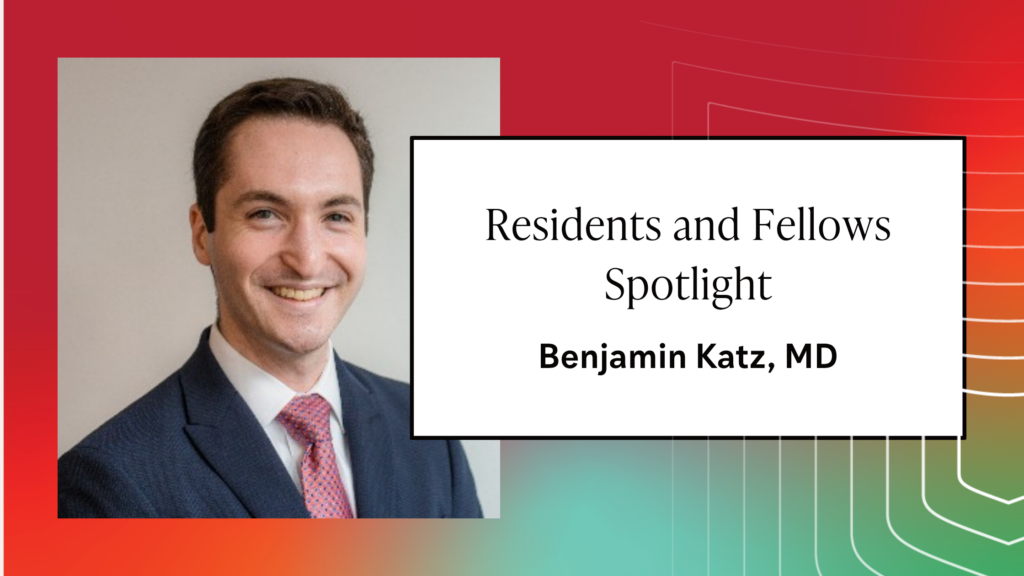
This spotlight series highlights the individuals behind the white coats, their journeys, passions, and the impact they’re making in the field of medicine. Today, we highlight Benjamin Katz, MD.
Graduating Fellow: Benjamin Katz, MD

What are your future plans?
I will be joining the Midwest Center for Sight, where I will be focusing on glaucoma and comprehensive ophthalmic care.
Why did you choose WashU Medicine?
WashU Medicine was a fabulous place to train. It was full of world-class, friendly mentors, great patients, and spectacular surgical volume and variety. The attendings truly want you to feel like a colleague, encouraging a first-name basis from day one, and even inviting fellows into their homes for events such as the annual crawfish boil. I was particularly drawn to the program’s emphasis on complex anterior segment pathology in addition to glaucoma, which has given me the confidence to know I have the tools to handle some of the most difficult cases.
What is your favorite memory of your fellowship?
One of my favorite moments from fellowship was the first time I independently took a patient for an emergent procedure overnight. Treating that patient and watching them improve throughout their recovery showed me how far I’d come in my training and gave me the confidence to know I’m ready for independent practice.
What aspect of your training do you feel most proud of?
During fellowship, I had a patient I was following who unfortunately had a complication following surgery. Her condition was particularly challenging to diagnose and took several surgeries to resolve. I assumed that, given the difficulty of her case, she would almost certainly ask that her care be handled solely by attendings. Instead, thanks to the rapport I’d built with her and her family, I was proud to remain an integral part of her care team, at times being the provider who saw her at post-ops, explained her condition, and walked her through the next surgical steps. Despite her difficult course, I was still her primary clinician at the end of the fellowship, and both she and her daughter told me they were glad I was able to be there to help guide them through such a difficult period.
How do you hope to make an impact in the field of ophthalmology?
I hope to make subspecialty glaucoma care more accessible to the patients who need it, while pushing the field forward through innovative, evidence-based approaches to treatment. Above all, I want to deliver individualized care with compassion, helping protect and preserve vision for every patient who walks through my door.
What advice do you have for incoming fellows?
You are surrounded by world-class glaucoma specialists. Even during a busy clinic, try to take some time afterward to make sure you understand why the attendings made the decisions they did, whether it’s which medication to add next, when to escalate to surgery, or how to choose between MIGS, a tube, or a trab. This will help you grow in your clinical decision-making skills.