Presentation at international meeting shows how specialized scleral lenses can dramatically improve vision in complex cases
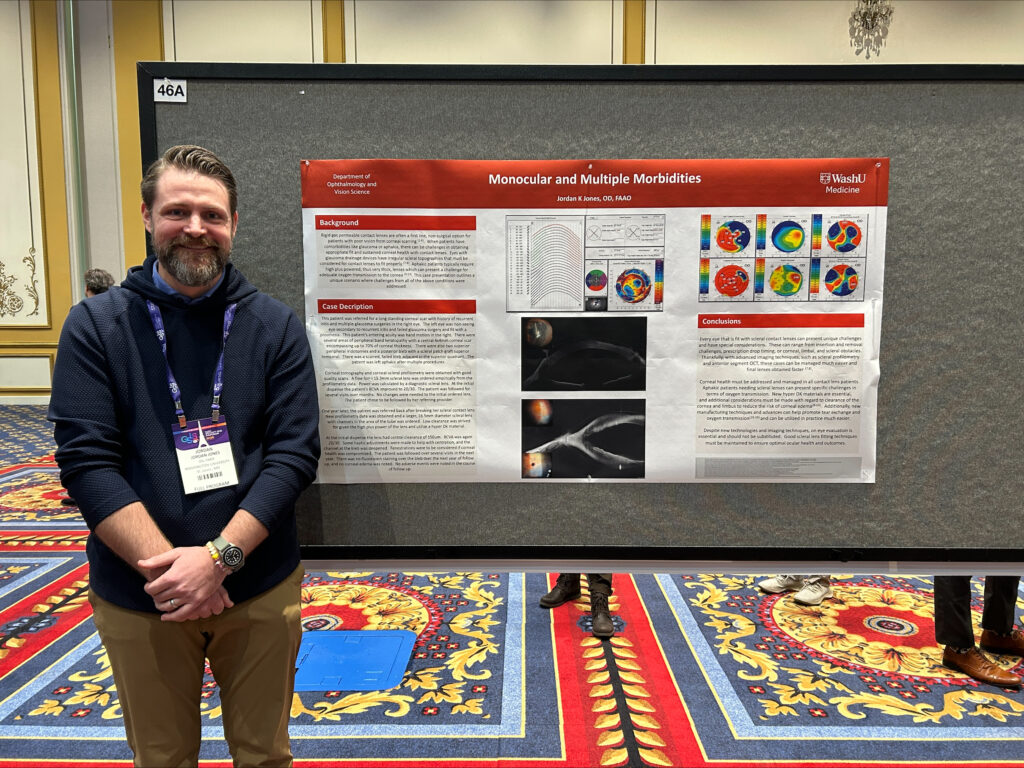
A complex contact lens case from the WashU Medicine John F. Hardesty, MD Department of Ophthalmology & Visual Sciences was recently featured at the Global Specialty Lens Symposium, where Jordan Jones, OD, FAAO, presented on advanced scleral lens fitting in patients with multiple ocular conditions.
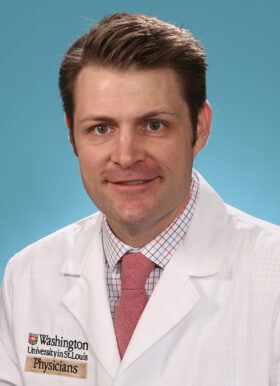
Jordan K. Jones, OD, FAAO
Instructor, Ophthalmology and Visual Sciences
- Email: jones.j.k@nospam.wustl.edu
Restoring Vision in a High-Risk, Single-Eye Patient
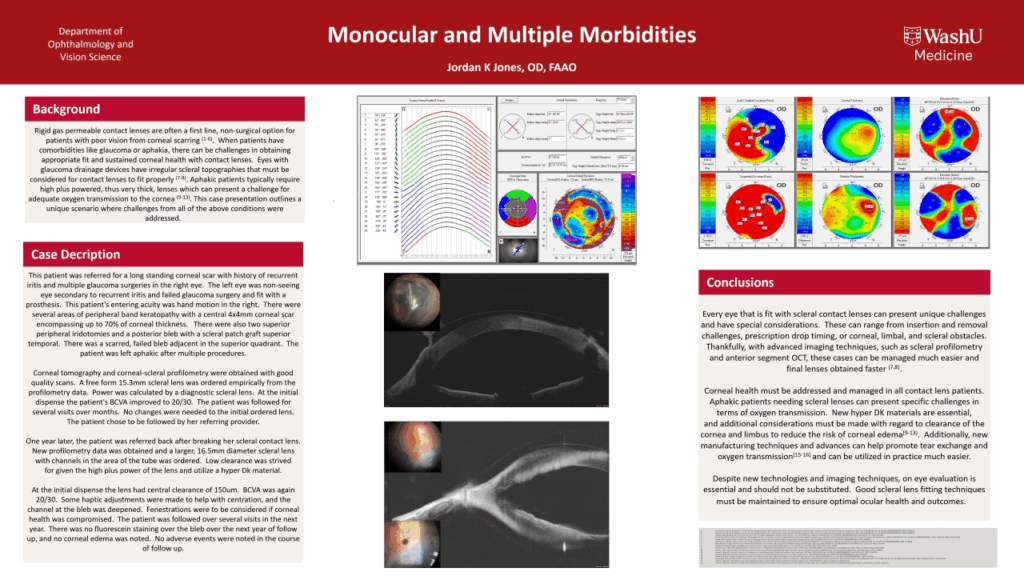
The presentation, titled Monocular and Multiple Morbidities, focused on a patient who had undergone multiple prior eye surgeries, resulting in significant corneal scarring and aphakia (absence of the natural lens). The patient also had a prosthetic left eye following several unsuccessful glaucoma surgeries, making protection of her remaining vision especially critical.
Before contact lens treatment, the patient’s vision was limited to counting fingers, and she relied on a cane for navigation.
Using advanced imaging and scleral lens fitting techniques, Jones was able to achieve a fit that was both comfortable and safe for long-term wear—an essential consideration for a patient relying on a single functional eye.
After successful fitting, the patient’s vision improved to 20/30, allowing her to resume daily activities with significantly greater independence. She has now been wearing the scleral lens successfully for more than three years without complications.
Expanding Options for Complex Patients
According to Jones, this case demonstrates how evolving technology and specialized fitting methods can expand treatment possibilities for patients who may not have been considered good candidates for scleral lenses in the past.
“This case shows how using advanced techniques can help patients who may previously have been unable to wear scleral contact lenses successfully,” he shared.
Why This Matters
Scleral lenses can play a critical role in restoring vision for patients with severe corneal disease, surgical complications, or complex anatomy, but achieving a safe and effective fit often requires specialized tools and expertise. Sharing these clinical experiences helps advance best practices and improves access to vision-restoring options for patients with the greatest need.
About WashU Medicine
WashU Medicine is a global leader in academic medicine, including biomedical research, patient care and educational programs with 2,900 faculty. Its National Institutes of Health (NIH) research funding portfolio is the second largest among U.S. medical schools and has grown 56% in the last seven years. Together with institutional investment, WashU Medicine commits well over $1 billion annually to basic and clinical research innovation and training. Its faculty practice is consistently within the top five in the country, with more than 1,900 faculty physicians practicing at 130 locations and who are also the medical staffs of Barnes-Jewish and St. Louis Children’s hospitals of BJC HealthCare. WashU Medicine has a storied history in MD/PhD training, recently dedicated $100 million to scholarships and curriculum renewal for its medical students, and is home to top-notch training programs in every medical subspecialty as well as physical therapy, occupational therapy, and audiology and communications sciences.