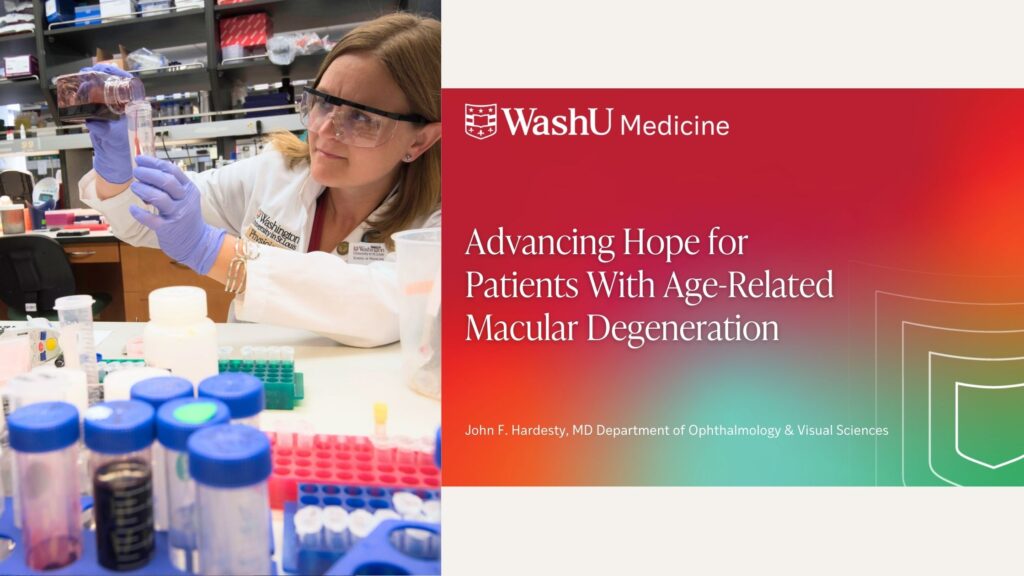
Age-related macular degeneration (AMD) remains the leading cause of blindness in adults over age 50, and while treatments exist for advanced stages of the disease, they are not curative or preventive. During Low Vision and AMD Awareness Month, researchers in the Rajendra S. Apte, MD, PhD and the Apte Lab within the WashU Medicine John F. Hardesty, MD Department of Ophthalmology & Visual Sciences are highlighting a critical shift in focus: stopping AMD before irreversible vision loss occurs. Rather than targeting only late-stage disease, the Apte Lab is dedicated to identifying early molecular drivers of AMD that could lead to future therapies aimed at prevention and disease interception.
“We are interested in developing future therapies that prevent AMD and halt progression prior to vision loss. Our work uses cutting-edge molecular tools to uncover novel pathways that could become the medicines of the future.”
Rajendra S. Apte, MD, PhD
This work is especially meaningful for patients because transformative discoveries often emerge from foundational science. While research is complex, time-intensive, breakthroughs can lead to entirely new ways of diagnosing and treating disease. In some cases, discoveries initially aimed at one eye condition reveal unexpected benefits for others. A notable example from the Apte Lab includes identifying abnormal metabolic pathways that contribute to AMD-related vision loss—findings that led to a first-of-its-kind clinical study at WashU Medicine / BJC evaluating whether an FDA-approved oral medication (currently used for another disease) could help treat geographic atrophy, an advanced form of dry AMD.
Looking ahead, the future of AMD care will depend on strong integration between discovery science, translational research, and clinical studies—along with continued investment in training the next generation of vision scientists and clinicians. For Apte, the greatest source of optimism comes from the people behind the science.
“The talented individuals I work with in the lab and clinic give me hope, they care deeply about research and about patients, and that commitment drives everything we do.”
Rajendra S. Apte, MD, PhD
As AMD Awareness Month continues, the work underway at WashU Medicine underscores a powerful message for patients and families: progress is happening—not just to slow vision loss, but to reimagine what AMD care could look like in the years ahead.
About WashU Medicine
WashU Medicine is a global leader in academic medicine, including biomedical research, patient care and educational programs with 2,900 faculty. Its National Institutes of Health (NIH) research funding portfolio is the second largest among U.S. medical schools and has grown 56% in the last seven years. Together with institutional investment, WashU Medicine commits well over $1 billion annually to basic and clinical research innovation and training. Its faculty practice is consistently within the top five in the country, with more than 1,900 faculty physicians practicing at 130 locations and who are also the medical staffs of Barnes-Jewish and St. Louis Children’s hospitals of BJC HealthCare. WashU Medicine has a storied history in MD/PhD training, recently dedicated $100 million to scholarships and curriculum renewal for its medical students, and is home to top-notch training programs in every medical subspecialty as well as physical therapy, occupational therapy, and audiology and communications sciences.