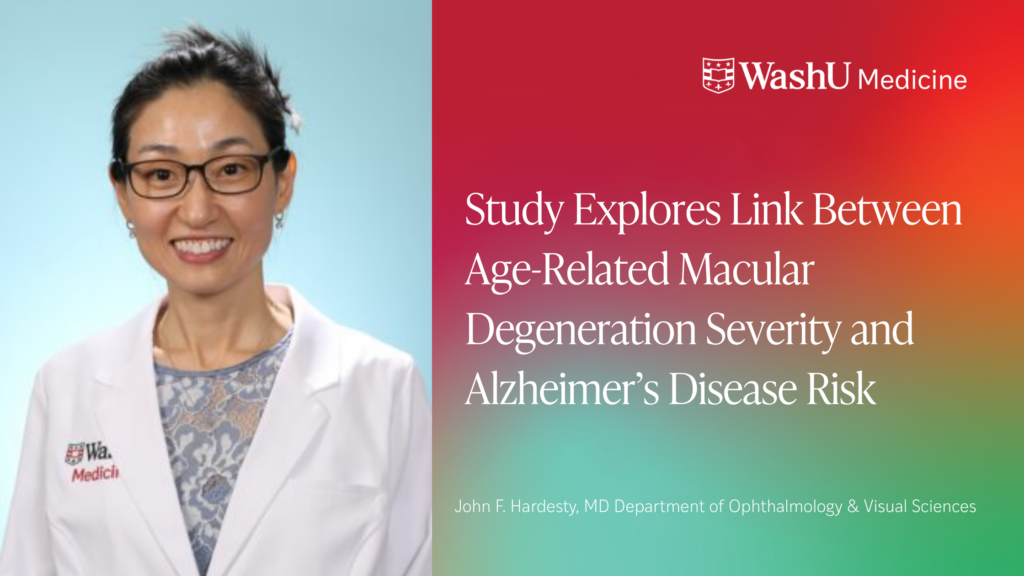
New publication highlights the potential of routine eye exams to support early brain health surveillance
Research by principal investigator Cecilia S. Lee, MD, MS, Jane Hardesty Poole Distinguished Professor at the WashU Medicine John F. Hardesty, MD Department of Ophthalmology & Visual Sciences, has been published in Alzheimer’s & Dementia: Diagnosis, Assessment & Disease Monitoring. The study, titled “Age-related Macular Degeneration Severity and Risk of Alzheimer’s Disease in Older Adults in a Prospective, Community-Based Cohort Study,” explored whether the severity of age-related macular degeneration (AMD) may help predict future risk of Alzheimer’s disease and related dementias.
The research was conducted using data from participants enrolled in the Adult Changes in Thought (ACT) study, a long-running, community-based study of aging and brain health led by Kaiser Permanente Washington Health Research Institute and the University of Washington. This work was further supported through the Eye ACT study, which focuses on understanding connections between eye health and neurodegenerative disease.
AMD is one of the leading causes of vision loss in older adults. In this study, researchers analyzed detailed information gathered during routine eye exams using electronic health records to evaluate the severity of both “dry” and “wet” forms of AMD on a continuous scale. Importantly, these severity scores could be calculated not only for patients diagnosed with AMD, but also for individuals showing early or subclinical signs of disease.

Cecilia Lee, MD, MS
Jane Hardesty Poole Distinguished Professor, Ophthalmology and Visual Science
- Email: cslee@nospam.wustl.edu
The researchers found that as AMD severity increased, the risk of developing Alzheimer’s disease also increased. Notably, the approach identified important Alzheimer’s risk information even among individuals without a formal AMD diagnosis, underscoring the potential value of routine eye care data in detecting broader health risks.
“What excites me most about this work is proving that routine data from everyday eye appointments contains hidden, invaluable signals regarding our broader brain health,” said Cecilia S. Lee, MD, MS. “By looking through the eye as a window to the brain, we hope to establish scalable, non-invasive surveillance tools that can identify who is at high risk of Alzheimer’s long before traditional cognitive symptoms appear, or before severe eye health deficits even develop.”
The findings support growing evidence that the eye may provide critical insights into neurological health and could help advance earlier, more accessible strategies for identifying individuals at elevated risk for Alzheimer’s disease.
Publication
Krakauer, C. A., Reilly, L., Xaiyamuangchanh, V. A., Su, Y. R., Walker, R. L., Cronkite, D. J., Lee, D., Arterburn, D. E., Gatto, N. M., Crane, P. K., Chew, E. Y., & Lee, C. S. (2026). Age-related macular degeneration severity and risk of Alzheimer’s disease in older adults in a prospective, community-based cohort study. Alzheimer’s & Dementia: Diagnosis, Assessment & Disease Monitoring.
DOI: https://doi.org/10.1002/dad2.70368
Related Resources
- Eye ACT Study: https://eyeactstudy.org
- ACT Aging Research: https://www.actagingr
About WashU Medicine
WashU Medicine is a global leader in academic medicine, including biomedical research, patient care and educational programs with 2,900 faculty. Its National Institutes of Health (NIH) research funding portfolio is the second largest among U.S. medical schools and has grown 56% in the last seven years. Together with institutional investment, WashU Medicine commits well over $1 billion annually to basic and clinical research innovation and training. Its faculty practice is consistently within the top five in the country, with more than 1,900 faculty physicians practicing at 130 locations and who are also the medical staffs of Barnes-Jewish and St. Louis Children’s hospitals of BJC HealthCare. WashU Medicine has a storied history in MD/PhD training, recently dedicated $100 million to scholarships and curriculum renewal for its medical students, and is home to top-notch training programs in every medical subspecialty as well as physical therapy, occupational therapy, and audiology and communications sciences.