Macular Degeneration: A Leading Cause of Vision Loss
Age-related macular degeneration (AMD) is the leading cause of blindness in adults over 50 in North America, affecting nearly 20 million Americans today. Globally, that number is projected to reach 300 million by 2040, with nearly two million people in the U.S. living with severe vision loss.
National Alliance for Eye and Vision Research (NAEVR), the Alliance for Eye and Vision Research (AEVR), supported by Research to Prevent Blindness (RPB), advocates for federal funding of the National Eye Institute (NEI) and educates policymakers on the critical importance of vision research. Through congressional briefings, these organizations raise awareness about the burden of eye disease, innovative research improving patient outcomes, and the importance of access to newly approved FDA treatments.
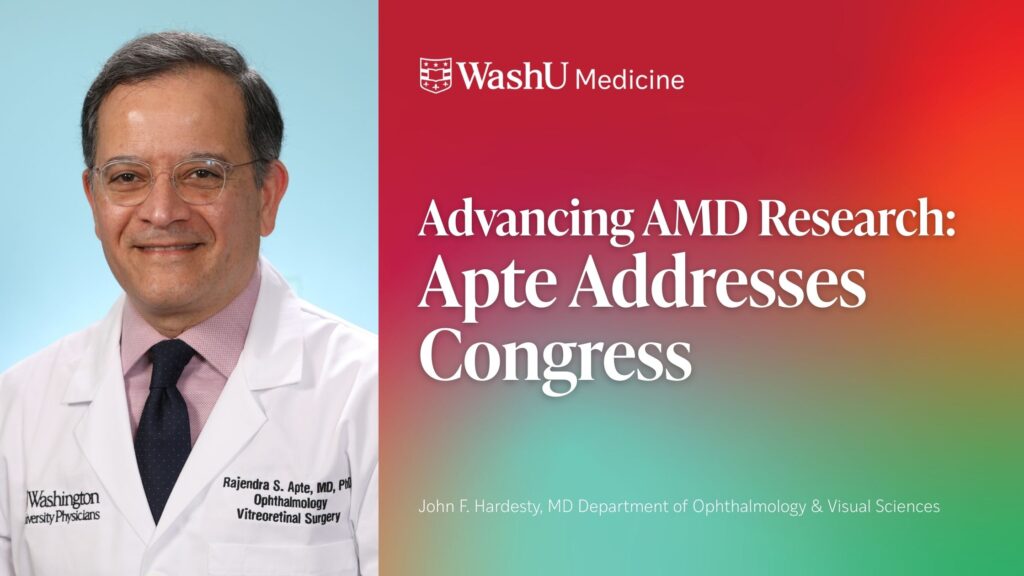
Rajendra Apte, MD, PhD, Paul A. Cibis Distinguished Professor of Ophthalmology and Visual Sciences at WashU Medicine’s John F. Hardesty, MD Department of Ophthalmology & Visual Sciences, was invited to present at a congressional briefing on AMD, hosted by NAEVR, AEVR, and RPB. His presentation showcased groundbreaking research emerging from WashU Medicine while highlighting the urgent need to address this growing public health challenge.
Apte explained how AMD damages the macula — the central portion of the retina responsible for detailed vision required for reading, driving, and recognizing faces. While early stages may not cause noticeable symptoms, progression can lead to distortion, blurred vision, and ultimately a central blind spot. He outlined the two advanced forms of the disease — wet (neovascular) AMD and dry AMD, which can progress to geographic atrophy, a neurodegenerative stage — and emphasized key risk factors including aging, genetics, smoking, and uncontrolled hypertension.
The support of the National Eye Institute and Foundations committed to vision research makes it possible for us to carry out critical studies aimed at discovering new ways to prevent and cure eye diseases. I am also deeply grateful to our patients and community members for their generous support of this visionary effort. My own research would come to a standstill without such support.
In addition to its profound personal impact, AMD carries a significant economic burden globally. Apte underscored the importance of early detection, community screening efforts, and sustained federal research support to accelerate new therapies and protect vision for millions of Americans.
Watch the full congressional briefing.
About WashU Medicine
WashU Medicine is a global leader in academic medicine, including biomedical research, patient care and educational programs with 2,900 faculty. Its National Institutes of Health (NIH) research funding portfolio is the second largest among U.S. medical schools and has grown 56% in the last seven years. Together with institutional investment, WashU Medicine commits well over $1 billion annually to basic and clinical research innovation and training. Its faculty practice is consistently within the top five in the country, with more than 1,900 faculty physicians practicing at 130 locations and who are also the medical staffs of Barnes-Jewish and St. Louis Children’s hospitals of BJC HealthCare. WashU Medicine has a storied history in MD/PhD training, recently dedicated $100 million to scholarships and curriculum renewal for its medical students, and is home to top-notch training programs in every medical subspecialty as well as physical therapy, occupational therapy, and audiology and communications sciences.