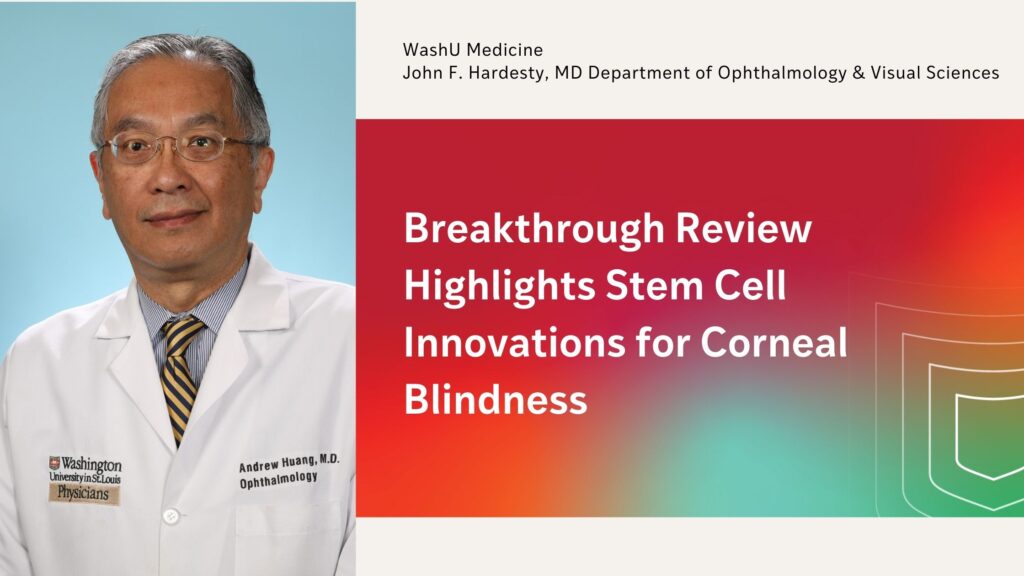
St. Louis, MO – September 10, 2025 – WashU Medicine John F. Hardesty, MD, Department of Ophthalmology & Visual Sciences is spotlighting advances in corneal regeneration, offering new hope for patients living with vision impairment due to corneal scars and opacities.
Corneal scars and opacities—often caused by trauma, infection, or chemical injury—are a leading cause of preventable blindness worldwide. While corneal transplantation has long been the gold standard for severe corneal dysfunction, its effectiveness is limited by the shortage of donor tissue and the risk of graft rejection.
A new publication, Stem Cell-Derived Corneal Epithelium: Engineering Barrier Function for Ocular Surface Repair, examines the current limitations of corneal transplantation and the potential for engineered corneal epithelium derived from autologous stem cells. These lab-grown tissues possess functional epithelial barrier properties that may one day bypass immune rejection and reduce dependence on scarce donor corneas.
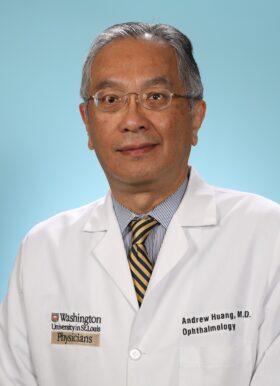
“The future of stem cell-engineered corneal epithelium is highly promising. Emerging innovations, such as gene-edited immune-evasive cell lines, biomimetic scaffolds, gene–cell combination therapies, and AI-driven graft strategies and economic evaluations, are collectively shaping a new paradigm of effective corneal regeneration for corneal blindness,”
Andrew Huang, MD, MPH, professor of ophthalmology in the John F. Hardesty, MD, Department of Ophthalmology & Visual Sciences.
This cutting-edge review underscores the importance of developing next-generation therapies that move beyond traditional corneal transplantation. With advancements in gene editing, biomaterials, and artificial intelligence, the field of ophthalmology is rapidly evolving toward safer, more accessible, and longer-lasting treatments for patients with corneal blindness.
About WashU Medicine
WashU Medicine is a global leader in academic medicine, including biomedical research, patient care and educational programs with 2,900 faculty. Its National Institutes of Health (NIH) research funding portfolio is the second largest among U.S. medical schools and has grown 56% in the last seven years. Together with institutional investment, WashU Medicine commits well over $1 billion annually to basic and clinical research innovation and training. Its faculty practice is consistently within the top five in the country, with more than 1,900 faculty physicians practicing at 130 locations and who are also the medical staffs of Barnes-Jewish and St. Louis Children’s hospitals of BJC HealthCare. WashU Medicine has a storied history in MD/PhD training, recently dedicated $100 million to scholarships and curriculum renewal for its medical students, and is home to top-notch training programs in every medical subspecialty as well as physical therapy, occupational therapy, and audiology and communications sciences.