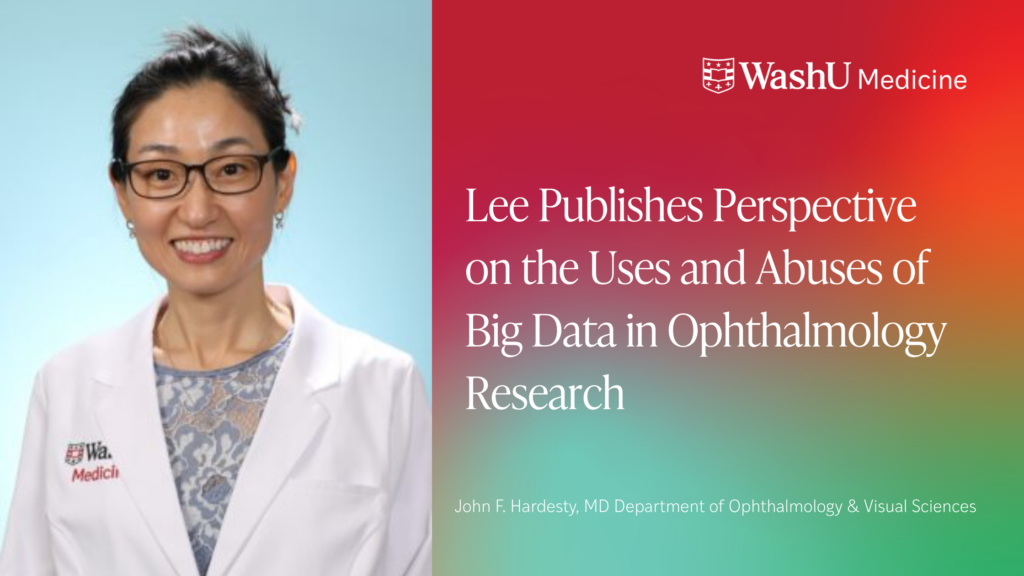
New article highlights the opportunities and challenges of leveraging large healthcare datasets to advance patient care
Cecilia S. Lee, MD, MS, of the WashU Medicine John F. Hardesty, MD, Department of Ophthalmology & Visual Sciences, recently published an article titled, “Uses and Abuses of Big Data in Ophthalmology Research” examining both the promise and potential pitfalls of utilizing large-scale healthcare data in vision research.

Cecilia Lee, MD, MS
Jane Hardesty Poole Distinguished Professor, Ophthalmology and Visual Science
- Email: cslee@nospam.wustl.edu
As electronic health records, medical imaging, and other digital health resources continue to expand, researchers have unprecedented access to vast amounts of patient data. These large datasets, often referred to as “big data,” have the potential to uncover new disease patterns, improve diagnostic approaches, and accelerate the development of personalized treatments.
In the publication, Lee explores how big data has transformed ophthalmology research while emphasizing the importance of rigorous scientific methodology when interpreting findings derived from large datasets.
“Big data is powerful, but only when paired with thoughtful study design, rigorous analysis, and critical interpretation”
Cecilia S. Lee, MD, MS
The article discusses several common challenges that can affect the reliability of big data research. These include inaccurate data labeling, missing or incomplete information, selection bias, and inappropriate statistical analyses. If not properly addressed, these issues can introduce hidden biases and lead to misleading conclusions that may not accurately reflect real-world patient outcomes.
Lee notes that while large datasets create valuable opportunities for scientific discovery, researchers must remain vigilant in evaluating data quality and study design. Findings generated from big data analyses should be critically assessed and validated in independent patient populations before being incorporated into clinical practice.
The perspective underscores the need for careful collaboration among clinicians, data scientists, and researchers to ensure that advances in data-driven medicine translate into meaningful improvements in patient care. By highlighting both the strengths and limitations of big data research, the article provides a framework for conducting more reliable and impactful studies in ophthalmology.
This work reflects the department’s ongoing commitment to advancing innovative research methods that improve the understanding, diagnosis, and treatment of vision-threatening diseases.