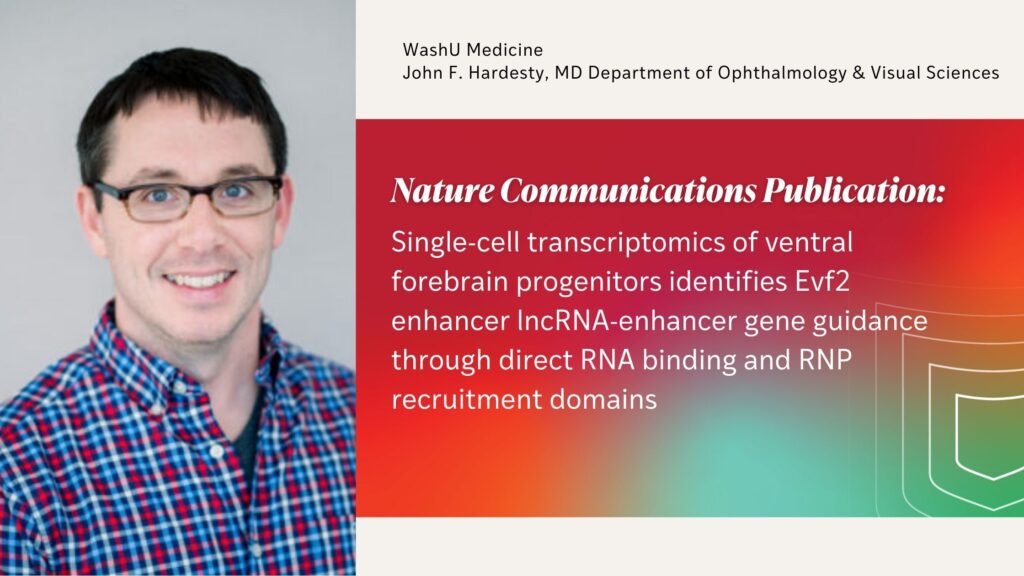
AUGUST 2025 – ST. LOUIS, MO — Brian Clark, PhD Assistant Professor, Ophthalmology and Visual Sciences, and colleagues have published a new study titled “Single-cell transcriptomics of ventral forebrain progenitors identifies Evf2 enhancer lncRNA–enhancer gene guidance through direct RNA binding and RNP recruitment domains”. This work provides new insights into how long non-coding RNAs (lncRNAs) influence the development of the brain’s intricate neural circuits.
The study focuses on Evf2, a specific enhancer lncRNA, and its critical role in regulating chromatin structure and RNA expression during the development and specification of forebrain interneurons—specialized cells that play a key role in brain signaling.
“This work highlights the role of long non-coding RNA (lncRNA) Evf2 in regulating chromatin structure and RNA expression during development and specification of forebrain interneurons,” said Dr. Clark. “As a significant fraction of the genome is transcribed into RNA, this work highlights the functional significance of lncRNAs during cell fate specification with broader implications for understanding the biological basis of neurodevelopmental disorders including Autism.”
Brian Clark, PhD
Key Findings
- Evf2 as a Developmental Guide — The study demonstrates that Evf2 directly binds RNA and recruits ribonucleoprotein (RNP) complexes to regulate genes essential for interneuron formation.
- Single-Cell Precision — Using single-cell transcriptomics, the team mapped Evf2’s activity in individual ventral forebrain progenitor cells, providing unprecedented detail of its function.
- Neurodevelopmental Implications — Understanding how Evf2 operates could advance research into the origins of disorders such as autism and epilepsy, where interneuron function is often disrupted.
Why It Matters
While only a small percentage of the genome codes for proteins, much more is transcribed into RNA—including lncRNAs whose roles remain poorly understood. Dr. Clark’s research sheds light on the molecular mechanisms by which these RNAs shape brain development, potentially opening new avenues for targeted therapies in neurodevelopmental disorders.
Publication Details:
Single-cell transcriptomics of ventral forebrain progenitors identifies Evf2 enhancer lncRNA-enhancer gene guidance through direct RNA binding and RNP recruitment domains
(2025) Nature Communications, 16 (1), art. no. 6902, .
About Brian Clark, PhD

Brian Clark, PhD
Assistant Professor, Ophthalmology and Visual Sciences
Brian Clark leads the Clark Lab, which investigates how the vertebrate retina develops from a pool of multi-potent retinal progenitor cells (RPCs). Using a combination of molecular biology and genetic techniques, the lab studies how gene regulatory networks control RPC proliferation, cell-cycle exit, and differentiation—work that aims to reveal how genetic aberrations contribute to retinal disorders. Current research areas include uncovering mechanisms that temporally regulate gene expression and cell fate, examining DNA methylation homeostasis during retinal specification, characterizing long non-coding RNA expression and scaffolding complexes, and conducting genome-wide profiling of cis-regulatory sequence activity during retinal development. The Clark Lab also develops novel tools to trace the epigenetic history of retinal cell types and identifies new gene mutations involved in inherited retinal diseases.
About WashU Medicine
WashU Medicine is a global leader in academic medicine, including biomedical research, patient care and educational programs with 2,900 faculty. Its National Institutes of Health (NIH) research funding portfolio is the second largest among U.S. medical schools and has grown 56% in the last seven years. Together with institutional investment, WashU Medicine commits well over $1 billion annually to basic and clinical research innovation and training. Its faculty practice is consistently within the top five in the country, with more than 1,900 faculty physicians practicing at 130 locations and who are also the medical staffs of Barnes-Jewish and St. Louis Children’s hospitals of BJC HealthCare. WashU Medicine has a storied history in MD/PhD training, recently dedicated $100 million to scholarships and curriculum renewal for its medical students, and is home to top-notch training programs in every medical subspecialty as well as physical therapy, occupational therapy, and audiology and communications sciences.