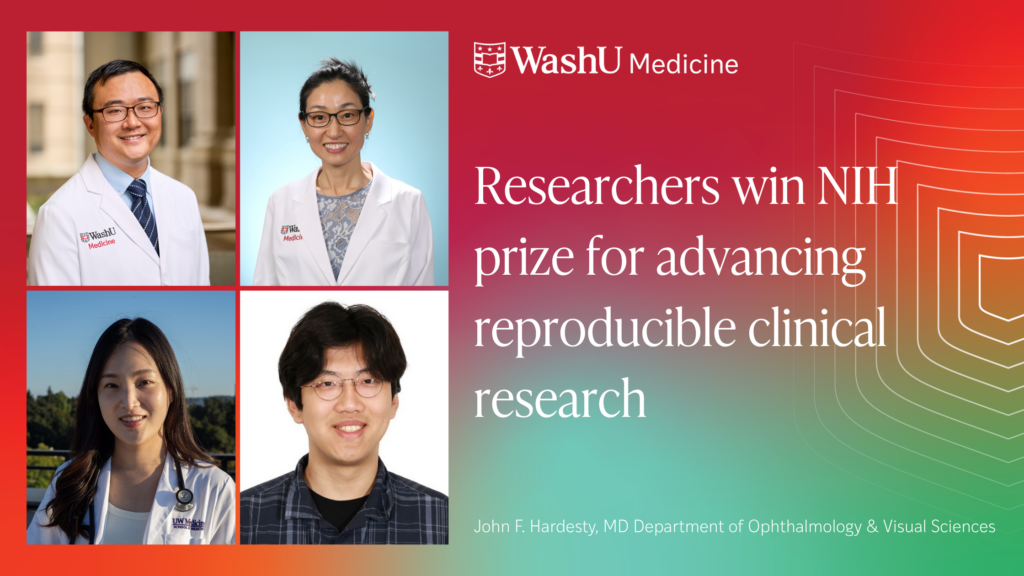
NIH Replication Prize: Shape the future of rigorous and replicable science.
Researchers at WashU Medicine, along with collaborators, were recognized by the National Institutes of Health (NIH) with a Replication Prize (Track 2: Replication Exemplars) for developing a framework to improve the speed and reproducibility of electronic health record (EHR)-based research, a form of clinical research that looks for patterns in patients’ electronic medical records to better understand diseases, treatments and health outcomes. The project, “An LLM-assisted framework for accelerated and verifiable clinical hypothesis testing from electronic health records,” helps make clinical research more transparent, reliable and reproducible.
The team includes WashU Medicine investigators Aaron Y. Lee, MD the Arthur W. Stickle Distinguished Professor and chair of the John F. Hardesty, MD, Department of Ophthalmology & Visual Sciences; Cecilia S. Lee, MD the Jane Hardesty Poole Distinguished Professor; Yu Jiang, PhD, a postdoctoral researcher; and Yuka Kihara, PhD, a senior scientist. The work grew out of a student-driven collaboration led in execution by Nayoon Gim, an MD/PhD student at the University of Washington, with supervision and mentorship from Lee and Lee. Additional collaborators include In Gim, a computer science PhD student at Yale University, and other contributors across multiple institutions.
The researchers developed LATCH (LLM (Large Language Model)-Assisted Testing of Clinical Hypotheses), a framework that uses clinical questions written in plain language to generate fully auditable analyses using electronic health record data organized into standardized categories, such as diagnoses, medications and lab results. The system uses artificial intelligence to organize hypotheses, while built-in workflows standardize how analyses are performed and reported so results can be independently verified.
Using diabetes as a test case, the team showed that LATCH could replicate findings from 20 published studies in 3-15 minutes per study and generate new insights by modifying the original hypotheses. In total, the researchers conducted 102 tests to reproduce findings from past studies, build on earlier research and identify potential new patterns in the data. The approach provides a scalable model for strengthening consistency and reproducibility in clinical research using real-world data.
About WashU Medicine
WashU Medicine is a global leader in academic medicine, including biomedical research, patient care and educational programs with 2,900 faculty. Its National Institutes of Health (NIH) research funding portfolio is the second largest among U.S. medical schools and has grown 56% in the last seven years. Together with institutional investment, WashU Medicine commits well over $1 billion annually to basic and clinical research innovation and training. Its faculty practice is consistently within the top five in the country, with more than 1,900 faculty physicians practicing at 130 locations and who are also the medical staffs of Barnes-Jewish and St. Louis Children’s hospitals of BJC HealthCare. WashU Medicine has a storied history in MD/PhD training, recently dedicated $100 million to scholarships and curriculum renewal for its medical students, and is home to top-notch training programs in every medical subspecialty as well as physical therapy, occupational therapy, and audiology and communications sciences.