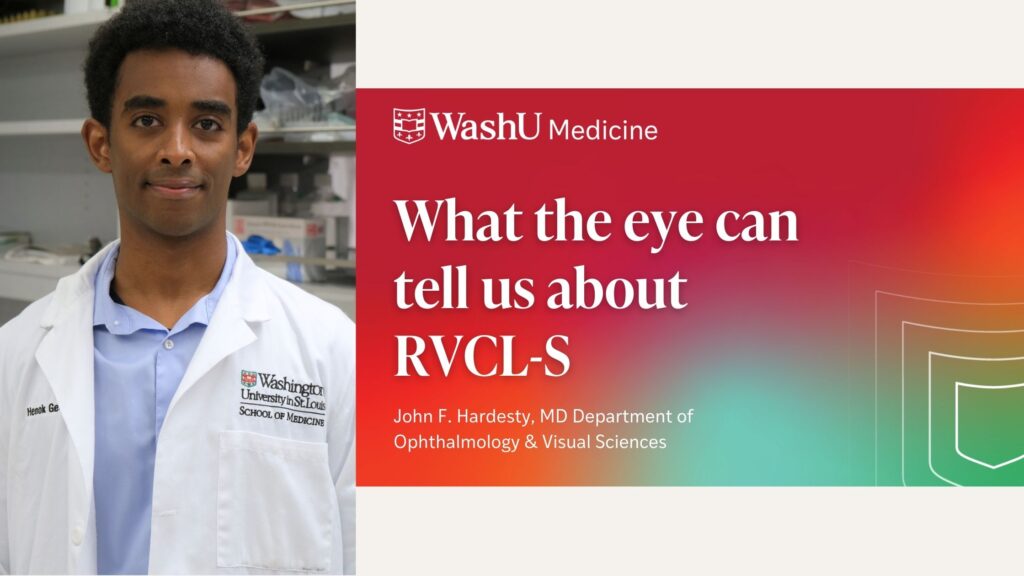
Researchers are learning that the eye may offer important clues about brain health, especially in people with retinal vasculopathy with cerebral leukoencephalopathy and systemic manifestations (RVCL-S)
In this study, led by medical student Henok Getahun, working in the Apte lab at WashU Medicine John F. Hardesty, MD Department of Ophthalmology & Visual Sciences, participants with RVCL-S underwent eye imaging (optical coherence tomography, or OCT) and brain MRI scans to examine whether changes in the retina reflect disease severity in the brain. Researchers focused on total macular volume (TMV), a measure of retinal structure important for central vision.
The results show that a smaller macular volume is associated with greater signs of brain injury on MRI, including damage to white matter. These findings suggest that TMV may serve as a noninvasive marker of cerebral disease severity in RVCL-S.
The eye is truly a window into the brain. In these studies, Henok demonstrated a correlation between macular volume and brain white matter loss in participants with a condition called retinal vasculopathy and cerebral leukoencephalopathy with systemic manifestations (RVCL-S).
– Rajendra Apte, MD, PhD
Getahun contributed to the study through his work in the Apte Lab, under the mentorship of Andria L. Ford, MD, MSCI, at WashU Medicine Department of Neurology and Rajendra Apte, MD, PhD, in the WashU Medicine John F. Hardesty, MD Department of Ophthalmology & Visual Sciences. Multiple other investigators at WashU Medicine and the University of Pennsylvania participated in this study.
About WashU Medicine
WashU Medicine is a global leader in academic medicine, including biomedical research, patient care and educational programs with 2,900 faculty. Its National Institutes of Health (NIH) research funding portfolio is the second largest among U.S. medical schools and has grown 56% in the last seven years. Together with institutional investment, WashU Medicine commits well over $1 billion annually to basic and clinical research innovation and training. Its faculty practice is consistently within the top five in the country, with more than 1,900 faculty physicians practicing at 130 locations and who are also the medical staffs of Barnes-Jewish and St. Louis Children’s hospitals of BJC HealthCare. WashU Medicine has a storied history in MD/PhD training, recently dedicated $100 million to scholarships and curriculum renewal for its medical students, and is home to top-notch training programs in every medical subspecialty as well as physical therapy, occupational therapy, and audiology and communications sciences.