Researchers from the WashU Medicine John F. Hardesty, MD Department of Ophthalmology & Visual Sciences have published a collaborative study in Scientific Reports that provides new insights into how inherited retinal diseases disrupt the organization of the retina and its blood vessels. The study, titled “Altered retinal cellular architecture and neurovasculature in CRX-associated retinopathy mouse models,” highlights a collaboration between the Chen Lab and the Apte Lab.
Led by Chi Sun, PhD, from the Chen Lab and Chas Pfeifer, MD, PhD, from the Apte Lab, the research investigated how two disease-causing mutations in the CRX gene affect retinal development in mouse models. The CRX gene plays a critical role in the development and function of photoreceptor cells—the specialized cells responsible for detecting light and enabling vision. Mutations in CRX are associated with rare inherited retinal disorders, including early-onset dominant cone-rod dystrophy (CoRD) and Leber congenital amaurosis (LCA), both of which can lead to severe vision loss beginning in childhood.
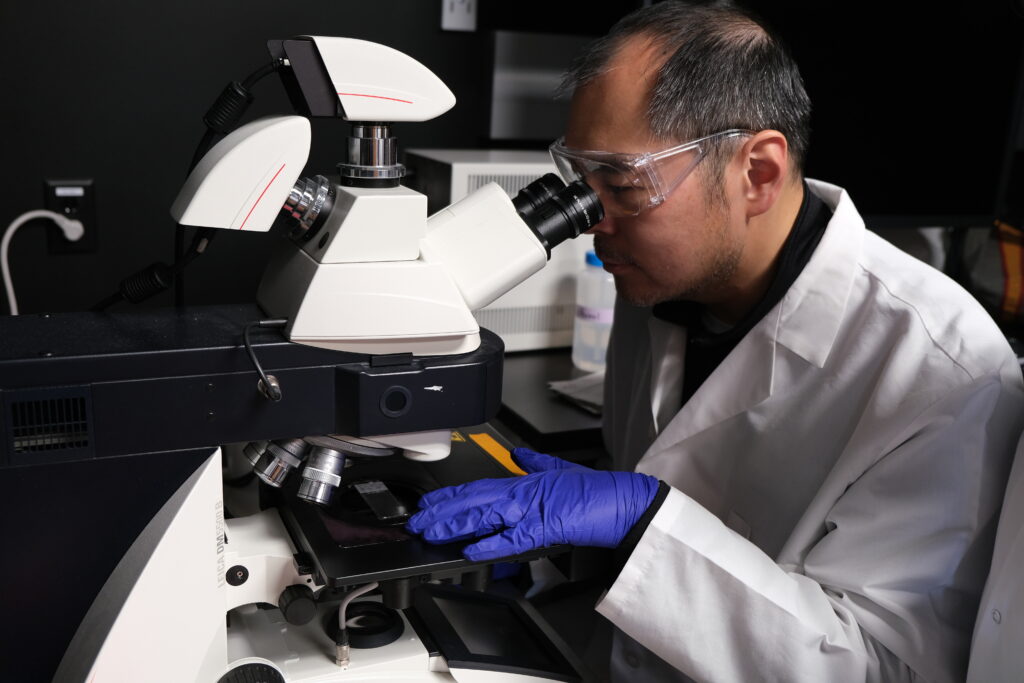
Previous work from the Chen Lab demonstrated that these mutations disrupt normal photoreceptor development, preventing the cells from maturing properly. In this new study, researchers discovered that these immature photoreceptors do not die as previously expected. Instead, they disrupt the retina’s highly organized layered structure, leading to the formation of abnormal retinal rosettes that alter the positioning of surrounding neurons and retinal blood vessels.
These previously unreported structural changes provide new insight into how inherited retinal diseases affect not only photoreceptor cells but also the surrounding neurovascular environment. Because narrowing of retinal blood vessels is frequently observed in patients with early-onset retinal diseases, the findings suggest that changes in retinal architecture and blood vessel organization may play an important role in disease progression and should be considered when developing future therapies.
The collaborative findings deepen researchers’ understanding of the complex relationship between photoreceptor development, retinal organization, and vascular health, providing an important foundation for future studies aimed at developing treatments for inherited retinal degenerative diseases.
About WashU Medicine
WashU Medicine is a global leader in academic medicine, including biomedical research, patient care and educational programs with 2,900 faculty. Its National Institutes of Health (NIH) research funding portfolio is the second largest among U.S. medical schools and has grown 56% in the last seven years. Together with institutional investment, WashU Medicine commits well over $1 billion annually to basic and clinical research innovation and training. Its faculty practice is consistently within the top five in the country, with more than 1,900 faculty physicians practicing at 130 locations and who are also the medical staffs of Barnes-Jewish and St. Louis Children’s hospitals of BJC HealthCare. WashU Medicine has a storied history in MD/PhD training, recently dedicated $100 million to scholarships and curriculum renewal for its medical students, and is home to top-notch training programs in every medical subspecialty as well as physical therapy, occupational therapy, and audiology and communications sciences.