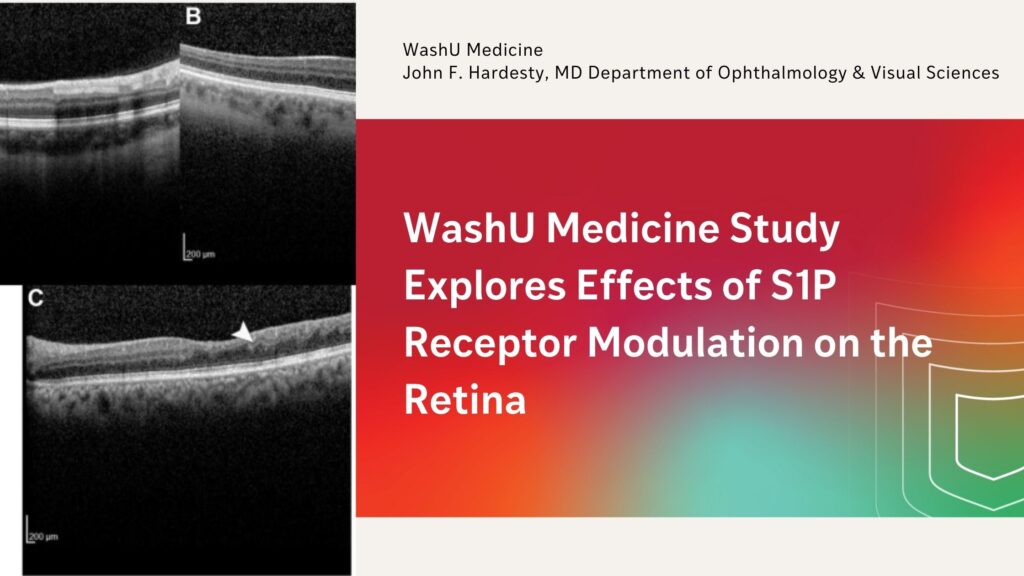
St. Louis, MO — August 27, 2025 — Researchers at the WashU Medicine John F. Hardesty, MD, Department of Ophthalmology & Visual Sciences in collaboration with the Department of Neurology have published new findings on the effects of sphingosine-1-phosphate (S1P) receptor modulation on the human retina. The study, led by the Apte Lab and published in Ophthalmology Science, is among the first to assess the impact of these therapies on human retinal structure.
Using non-invasive optical coherence tomography (OCT), the team examined both inner and outer retinal layers in MS patients treated with S1P receptor modulators. Results show that while inner retinal thinning consistent with MS progression was observed, outer retinal layers, including the retinal pigment epithelium (RPE) and photoreceptors, remained stable. These findings suggest that S1P modulation may not negatively affect retinal integrity and could have a protective role.
“Our study is one of the first to closely examine how S1P receptor modulation affects the retina in human patients. These early results are promising, but they highlight the need for larger, prospective studies to fully understand whether S1P pathways can be harnessed to protect vision in MS and other retinal diseases.”
Wilson Wang, MD, MPhil
Key Research Takeaways
- Inner retinal changes: Ganglion cell layer and macular volume continued to decline, reflecting known MS-related neurodegeneration.
- Outer retinal preservation: RPE and photoreceptor layers remained structurally stable, an area of uncertainty prior to this study.
- Clinical implications: Findings reinforce the value of OCT for monitoring MS progression and open new avenues for studying S1P signaling in eye health.
Collaborative and Interdisciplinary Research
The research highlights the collaborative efforts between Ophthalmology and Neurology at WashU Medicine.
“This real-world study highlights ongoing and productive collaborations between Ophthalmology and Neurology,” said Robert Naismith, MD, Professor of Neurology. “WashU is dedicated to studying the impact of multiple sclerosis and disease-modifying therapies on visual outcomes for our patients.”
Student Contributions and Mentorship
The study also featured meaningful involvement from WashU medical students, who contributed to study design and data analysis. Fourth-year medical student Henok Getahun and third-year medical student Helen Rossmiller expressed gratitude for working alongside such a knowledgeable team and contributing to the research.
“Involving medical students early in the research process is a critical investment in the future of academic ophthalmology,” said Rajendra Apte, MD, PhD, Paul A. Cibis Distinguished Professor of Ophthalmology and Visual Sciences. “By engaging trainees in meaningful clinical studies, we not only cultivate their scientific curiosity, but foster the next generation of clinician-scientists who will advance both discovery and care.”
Looking Ahead
The findings represent an initial step toward understanding the role of S1P receptor modulation in eye health, particularly in the context of MS. While promising, researchers emphasize that more clinical studies are needed to determine how these pathways might be leveraged in other retinal diseases such as age-related macular degeneration.
About WashU Medicine
WashU Medicine is a global leader in academic medicine, including biomedical research, patient care and educational programs with 2,900 faculty. Its National Institutes of Health (NIH) research funding portfolio is the second largest among U.S. medical schools and has grown 56% in the last seven years. Together with institutional investment, WashU Medicine commits well over $1 billion annually to basic and clinical research innovation and training. Its faculty practice is consistently within the top five in the country, with more than 1,900 faculty physicians practicing at 130 locations and who are also the medical staffs of Barnes-Jewish and St. Louis Children’s hospitals of BJC HealthCare. WashU Medicine has a storied history in MD/PhD training, recently dedicated $100 million to scholarships and curriculum renewal for its medical students, and is home to top-notch training programs in every medical subspecialty as well as physical therapy, occupational therapy, and audiology and communications sciences.