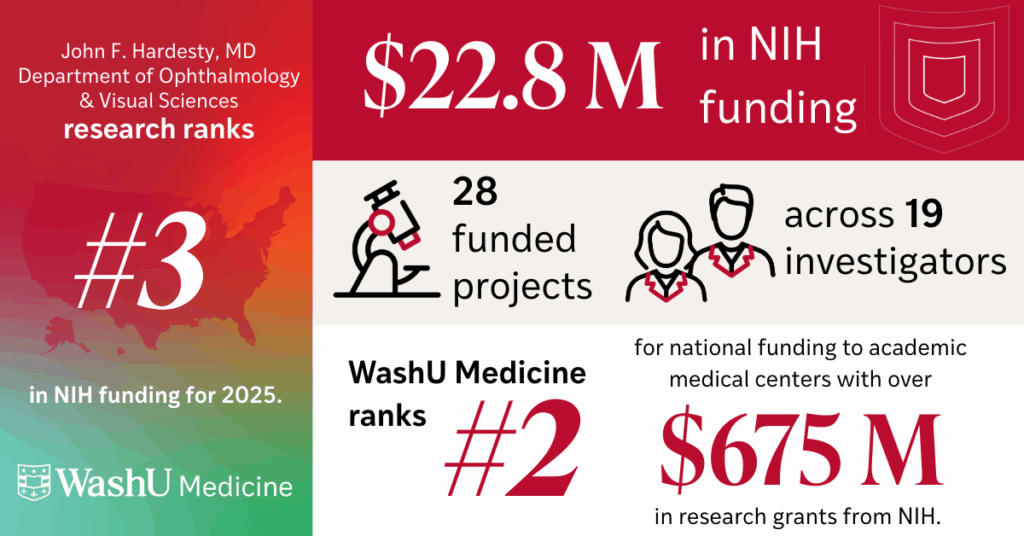
WashU Medicine Ophthalmology has been ranked No. 3 in the nation in National Institutes of Health (NIH) funding among ophthalmology departments, according to the 2025 Blue Ridge Institute for Medical Research (BRIMR) rankings.
WashU Medicine John F. Hardesty, MD Department of Ophthalmology & Visual Sciences continues to demonstrate national research leadership, securing $22,793,703 in NIH funding across 28 awards led by 19 principal investigators (PIs).
This milestone reflects the department’s sustained commitment to advancing discovery in vision science and developing innovative therapies that improve patient care.
Among individual investigators, Aaron Y. Lee, MD, MSCI, ranked #1 nationally in NIH funding among ophthalmology principal investigators, and Cecelia Lee, MD, ranked #2 nationally — an extraordinary achievement that highlights WashU Medicine’s strength in both scientific innovation and collaborative research leadership.
At the institutional level, WashU Medicine ranked #2 among all U.S. medical schools for total NIH funding, further highlighting the depth and breadth of its research enterprise.
The department’s 28 funded projects span a broad range of vision science priorities, including artificial intelligence and deep learning in ophthalmology, retinal disease, glaucoma, corneal biology, and translational therapeutics. These awards support fundamental discovery science, clinical trials, and next-generation data initiatives designed to accelerate breakthroughs from laboratory to clinic.
Ranking #3 nationally with nearly $23 million in NIH funding reflects the exceptional creativity of our 19 principal investigators. This support empowers us to pursue fundamental discoveries about the visual system and translate those insights into new treatments. A special congratulations to Aaron and Cecilia Lee for securing the #1 and #2 spots nationally—a phenomenal accomplishment that highlights the caliber of ophthalmic research here at WashU.
Daniel Kerschensteiner, MD
Bernard Becker Professor of Ophthalmology and Visual Sciences, Vice Chair for Research in Ophthalmology and Visual Sciences, Co-Director of the Neuroscience Ph.D. Program
With 19 funded principal investigators, the department’s collaborative research culture remains central to its success. NIH funding not only advances critical scientific discovery but also supports the training of future clinician-scientists, fellows, and trainees who will lead the next era of vision research.
As vision-threatening diseases continue to impact millions of patients worldwide, WashU Medicine Ophthalmology & Visual Sciences remains focused on translating discovery into meaningful, measurable improvements in patient outcomes — reinforcing its position as a national leader in academic ophthalmology.
Our NIH/NEI funded investigators
Steven Bassnett, PhD – Anterior Segment and Glaucoma Research
Bassnett’s lab studies the biology and pathology of the eye’s anterior segment, including lens development and glaucoma. Current projects focus on how physical forces shape the lens and identifying novel approaches to diagnosing and treating exfoliation glaucoma.
Shiming Chen, PhD – Photoreceptor Gene Regulation
Chen’s lab deciphers the genetic mechanisms that control photoreceptor development and maintenance, focusing on transcription factors, particularly CRX. Mutations in the human CRX gene cause inherited blinding diseases without a cure. The team aims to understand the impact of mutations on CRX function and develop gene-based therapies to restore vision.
Brian Clark, PhD– Retinal Development and Epigenetics
Clark’s lab explores how retinal progenitor cells differentiate into specialized neurons. Using molecular and genetic tools, the team investigates DNA methylation, long non-coding RNAs, and regulatory elements involved in retinal cell fate and inherited retinal disorders.
Thomas Ferguson, PhD – Autophagy and Retinal Health
Ferguson’s lab examines how autophagy supports retinal function and immune regulation. His research explores the role of autophagy in photoreceptor survival, visual cycle maintenance, and immune tolerance mechanisms relevant to degenerative eye diseases.
Mae Gordon, PhD & Michael Kass, MD – Glaucoma Research and Clinical Trials
Gordon and Kass focus on glaucoma diagnosis, treatment, and progression. Their research emphasizes informed collaborative decision-making between patients and clinicians, focusing on risk assessment, optimal frequency of visits and tests, and the potential benefits of early treatment. Their recent work explores the impact of glaucoma on patient quality of life.
Andrew JW Huang, MD, MPH – Ocular Surface Wound Healing and Corneal Neurobiology
Huang’s lab investigates corneal epithelial wound healing and regeneration of Meibomian glands in the eyelids. In collaboration with Qin Liu, PhD, in the Department of Anesthesiology, their team studies the sensory innervation of the ocular surface. Their work has revealed an anatomical and functional dichotomy in ocular surface sensation, with the cornea primarily sensitive to pain and the conjunctiva sensitive to itch. They also identified a previously unrecognized sneezing pathway that parallels the neuro-regulation of conjunctival itch.
Daniel Kerschensteiner, MD – Retinal Circuitry and Vision Processing
Kerschensteiner and Soto study how neural circuits in the retina process visual information and how diseases disrupt these pathways. Their interdisciplinary approach integrates imaging, electrophysiology, and computational modeling to understand visual signal transmission.
Aaron Y Lee, MD, MSCI – Artificial Intelligence and Retinal Imaging
Lee’s research centers on artificial intelligence, deep learning, and large-scale model development for healthcare. He focuses on creating interpretable and generalizable algorithms using multimodal health data, including retinal imaging and electronic health records.
Cecilia Lee, MD, MS – Retinal Biomarkers and Population Eye Health
Lee’s research integrates retinal imaging, clinical epidemiology, and big data to study the eye as a biomarker of systemic and neurodegenerative diseases. Her work focuses on population-based research, AI-driven analysis, and the development of non-invasive retinal biomarkers to advance early detection, prevention, and precision health in aging and chronic conditions such as Alzheimer’s disease and diabetes.
Josh Morgan, PhD – Synaptic Organization in Visual Circuits
Morgan’s lab use light and electron microscopy to understand the synaptic organization of the visual system. His research explores how visual circuits form, process information, and adapt to damage.
Rithwick Rajagopal, MD, PhD – Diabetic Retinopathy and Neuronal Damage
The Rajagopal Laboratory investigates the mechanisms behind blinding retinal diseases, with a focus on how retinal metabolism interacts with retinal blood supply. To explore this, we conduct both preclinical studies in mouse models and translational clinical research. High-resolution retinal imaging, particularly optical coherence tomography and angiography, is central to their work which spans ophthalmology, neuroscience, and metabolism.
Margaret M. Reynolds, MD – Pediatric Ophthalmology
Reynolds lab investigates the role of vision in the pathogenesis of autism spectrum disorder. She studies how visual impairment affects autism spectrum disorder phenotype as well as functional connectivity in the brain. A recent major focus of the lab has been how reversing visual impairment via refractive surgery affects behavioral phenotype and brain biomarkers.
Philip Ruzycki, PhD – Epigenetics in Retinal Development and Disease
Ruzycki’s lab studies gene regulation in the retina, focusing on histone modifications, enhancer function, and cell fate determination. His work provides insights into aging and retinal disease progression.
Carla Siegfried, MD – Glaucoma Disparities and Precision Therapies
Given the racial disparities of glaucoma prevalence, increased severity and vision loss, more rapid progression and earlier onset in African Americans, Dr. Siegfried’s lab studies the basic physiology of the trabecular meshwork, specialized cells that regulate intraocular pressure. Recent work has revealed racial differences in mitochondrial function and antioxidant protection of trabecular meshwork cells. By improving our understanding of these fundamental mechanisms of the disease, they hope to identify novel therapies.
Gregory Van Stavern, MD – Neuro-Ophthalmology
Van Stavern’s research investigates neuroimmunology, multiple sclerosis, and idiopathic intracranial hypertension, with a focus on improving diagnostics and treatments for vision-related neurological disorders.
James Walsh, MD, PhD – Ocular Immunology and Disease Pathogenesis
Walsh’s lab combines basic science and translational studies to investigate how the immune system is incorporated into the eye during health, how these interactions change during ocular disease, and how these eye-specific mechanisms used by the immune system can be targeted to develop eye-specific therapies for ocular diseases.
Philip Williams, PhD – Neuronal Regeneration and Neuroprotection
Williams’s lab focuses on strategies to preserve and regenerate neurons after central nervous system injuries. Using the eye as a model, his team explores neuroprotection and axon regeneration approaches.
Takeshi Yoshimatsu, PhD – Visual System Development and Regeneration
Yoshimatsu’s lab investigates how the retina develops specialized regions for high-acuity vision and why these areas are vulnerable to disease such as age-related macular degeneration. His research uses zebrafish and other model systems to study retinal degeneration and potential therapeutic intervention
About WashU Medicine
WashU Medicine is a global leader in academic medicine, including biomedical research, patient care and educational programs with 2,900 faculty. Its National Institutes of Health (NIH) research funding portfolio is the second largest among U.S. medical schools and has grown 56% in the last seven years. Together with institutional investment, WashU Medicine commits well over $1 billion annually to basic and clinical research innovation and training. Its faculty practice is consistently within the top five in the country, with more than 1,900 faculty physicians practicing at 130 locations and who are also the medical staffs of Barnes-Jewish and St. Louis Children’s hospitals of BJC HealthCare. WashU Medicine has a storied history in MD/PhD training, recently dedicated $100 million to scholarships and curriculum renewal for its medical students, and is home to top-notch training programs in every medical subspecialty as well as physical therapy, occupational therapy, and audiology and communications sciences.